In association with:

In association with:

Day 6: Marine Protected area at De Hoop Nature Reserve

No wonder a specialist in sea life is very eager and ready to start early, travel 3 hours on mostly gravel roads to reach a special destination of the Marine Protected area at De Hoop. This protected area extends 3 nautical miles (5 km) out to sea and is one of the largest marine protected areas in Africa and provides a sanctuary for a vast and fascinating array of marine life! 

On arriving at De Hoop Nature Reserve - one of the largest natural areas managed by Cape Nature Conservation. (app. 34 000ha in size) - everybody was impressed by the beautiful setting of white dunes against the backdrop of lush fynbos, traditional homesteads and wildlife (especially the interesting Bontebok).

De Hoop Nature Reserve forms part of the world's smallest and most threatened plant kingdom - the Cape Floral Kingdom. Fynbos is the dominant vegetation group and is largely confined to nutrient-poor soils in the winter rainfall areas of the Western Cape. It is adapted to fire and drought and is defined by four growth forms: proteas, ericas, restios and geophytes. De Hoop Nature Reserve is important for the conservation of lowland fynbos as it has the largest conserved area for this rare vegetation type. It is considered as one of the flagship Fynbos Biome reserves. 

De Hoop is a World Heritage Site and a Ramsar Wetland site. De Hoop is famous for its variety of resident and migratory birdlife and more than 260 species have been recorded on the reserve. The De Hoop Vlei attracts large numbers of water birds. The only remaining breeding colony of the rare Cape vulture in the Western Cape occurs at Potberg.

De Hoop Nature Reserve
De Hoop Homestead Historical Monument
Baboons and water birds wading side by side
Bontebokke
Sea view with traditional house
The scientists were more than pleased with the finds of the day and the plant team found species that they have not yet sampled.
Plant team with Millene
The snails at De Hoop were too big to be collected in the little bottles provided for finds and impressed the mollusk team with their size and colour.

Zebra Agate  Snail
Linda Davis of the snail team
The continuous dribble could not deter Herman and his team and they were very happy with their catch of the day and eager to get back to the lab at Klipbokkkop to identify the collected samples.

Dr. Monica Mwale and Murray Duncan

We crossed the Breede River at Malgas with the pontoon and the passengers were impressed by the oldest hand operated ferry in South Africa which is in use for at least a hundred years. For many years the pont was powered singlehandedly by Moxie Dunn. Now three men have to do the work.  

Monica and Murray exited about their find of the day
Malgas Pontoon
Manually operated
Find of the day

The find of the day was the beautiful red-edgedtipped Blennioclinusbrachycephalus. This is a striking clinid with an eye spot that has bright blue semicircular colouring. Other samples were three species of the endemic Caffrogobius, C. caffer, C. nudicepsand C. saldhanha. Overall they collected ten species and were very pleased with their collection.

11 Find of the Day Blennioclinusbrachycephalus

Day 5: Unique & rare find in the Bainskloof Pass

Another perfect day for searching and collecting those evasive specimens still not found, and the 6 Toyota Hilux and Fortuners vehicles with all members of the different scientific teams and members of the media set off for Bainskloof,  about 50km west of Worcester.


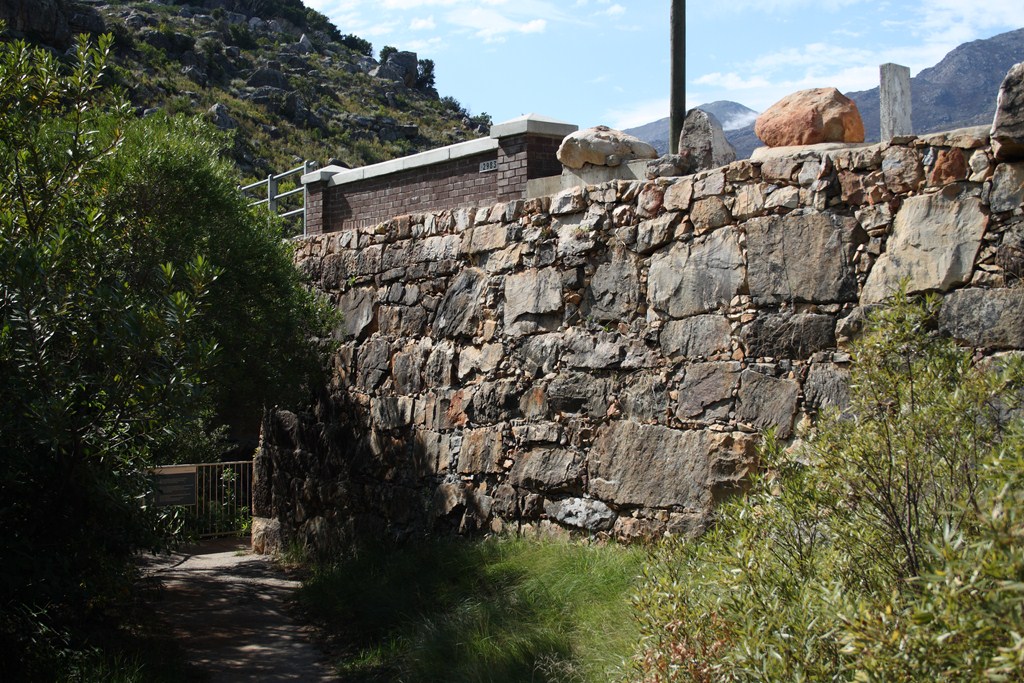
 Bains Kloof Bridge
Group Pic
After completing the Michell’s Pass in 1840, Andrew Geddes Bain decided to build a pass through the Wellington Mountains. He was one of the famous Bain construction engineers who built many passes in South Africa.

Bain described the landscape as “repulsive and savagely grand” and “for the first three miles we had nothing but crossing and recrossing the river and climbing up the mural banks at the risks of our necks, so gloomy was this place, there is a perfect absence of animal life.”

Work started in February 1849 on the easier western approach. This section required little blasting, and two timber bridges and four stone culverts. He also had 300 oaks planted for shade.
He also tried to shorten this part of the route by building a 122m tunnel, but the rock face soon proved too unstable and dangerous. In 1851 he moved his camp to Tweede Tol to start work on the remaining, more difficult part of the pass. Ten kilometers of road had to be blasted through solid rock, and in places 20m high retaining walls had to be built.The workers used little more than hand drills, sledge hammers, steel bars, picks and shovels.
Most of the work was done by convict labour - between 300 and 350 people at a time. Sometimes the figure went up to 450. About 1,000 convicts could claim that they were involved in building the 30 km pass.
The pass was opened in September 1853 and is still in use today - with a few minor improvements like getting a tarred surface in 1934.

It became a national monument in 1980.
Dr. Dai Herbert
The scientists who are looking for mollusks or snails had a very successful day and found a very rare and poorly known species. There are very few records for this particular snail and it seems to be confined to the mountains in the region between Wellington, Ceres and the Grootwinterhoek area. It belongs to a family of snails, the Dorcasiidae, that is endemic to south western Africa. Most of the species live near the coast and some are capable of living in near desert environments, but this one is unusual in that it occurs in montane fynbos. Our snail folk were also pleased to find some living examples of a small pinwheel snail, which again seems to be a species restricted to montane fynbos. In these habitats snails are very few and far between, but the few that do occur there are particularly interesting and their conservation is a matter of concern because of their limited distribution.

Find of the day -Tulbaghinia Isomeriodes
Mary Cole
A few comments from the Mollusk Expert Group
According to Dai Herbert (Kwazulu‐Natal Museum), with its emphasis on the barcoding of alien and invasive species, Toyota Enviro Outreach 2012 will make an important contribution to our knowledge of introduced snails and slugs in South Africa. Many of the most adept hitchhiking snails belong to families where the differences between species are small and they are therefore difficult to identify – even for specialists in their native range. This problem is even greater in countries to which the animals are introduced, because the necessary taxonomic expertise is often lacking. As a result some introduced species have in the past been mistakenly redescribed as newly discovered native species. Currently we know of 34 snail and slug species, which have been introduced to South Africa, but there are a number of others around which raise questions – both regarding their identity and whether or not they represent introductions. DNA barcode data promise to provide valuable insights relating to these questions, helping us to obtain a more accurate picture of the alien terrestrial mollusc fauna of South Africa. A number of species have invaded natural habitats and some are amongst our worst agricultural pests. In this regard the Western Cape is the most adversely effected region with over 30 introduced snail and slug species. Mary Cole (East London Museum) – One difference between indigenous forests in the Western Cape and forests in other provinces where I have collected (i.e. Eastern Cape and Kwazulu‐Natal) is that there are many alien snails in the Western Cape indigenous forests, both in terms of numbers of different species of invasives, and they can be abundant. Forests where I have observed this include: indigenous forests above Kirstenbosch,

Grootvadersbosch and Platbos near Gansbaai. In other respects the forests appear pristine until one scratch in the leaf litter. In the Eastern Cape, and elsewhere, invasive snails are confined mainly to gardens, and while one may come across the occasional slug in indigenous forests, one seldom encounters alien snails. Alien snails and slugs have been in the Western Cape a lot longer than in other provinces, but it is more likely that the climate or other abiotic and/or biotic environmental factors favours them more there than in other provinces, and hence they have been able to establish themselves with greater success. This project will strive to increase our knowledge regarding global biodiversity. 

Cornus apserum (formally Helix aspera) introduced European garden snail, was observed

Reflections of the day:


Day 4: Botanists' Heaven at Grootvadersbosch

Nobody wanted to miss out on the trip to Grootvadersbosch today. This Cape Nature reserve of 250ha of forest is unique in the Southern Western Cape and the largest remaining example in the Langeberg. The forest was named after one of the original owners, Roelof Oelofse, whose nickname was Groot Vader and who received this property in 1723.


Situated adjacent to the forest is a large fynbos area where most of the scientists aimed for.

Prof Eric Holm identified the largest cockroach of its kind who keeps in the fynbos. He explained why the cockroaches will always survive. Being generalist, they thrive on anything, as we know, and have no special diet, habitat or any natural enemies. Only the 4 house cockroach species are aliens.


Prof Erik Holm ready for action
Aptera Sp or Fynbos Cockroach endemic and can be winged or apterous.
The female is the largest in SA and is apterous and burroughs 
Botanist team heading out into Grootvadersbosch
Erica Blenna or Riversdale Heath
Prof Charles Whitehead of University of Johannesburg came to visit
Finally lunch break!
Dr Stephen Boatwright is a botanist working at Kirstenbosch in the Compton Herbarium with special field of interest in alien plants.

He works closely with the Early Detection and Rapid Response Unit for alien plants and he also work with Working for Water.
Dr. Stephen Boatwright of SANBI

The Early Detection and Rapid Response Programme were started in 2008 by the Natural Resources Management Programmes of the Department of Environmental Affairs and the South African National Biodiversity Institute (SANBI). 

This program, as the name says, focuses on the detection and control or eradication of emerging alien species that have the potential to become problematic in the country. The SANBI is mandated to conserve South Africa’s biodiversity and monitor and report on invasive species.

The EDRR programme is currently involved in a project on the barcoding of invasive plant and animal species in South Africa. This project is a collaborative effort between the EDRR and the African Centre for DNA Barcoding (ACDB) at the University of Johannesburg. It aims to slot in with the International Barcoding of Life Project (iBOL) by building a DNA barcoding database of invasive plant and animal species in South Africa, also including native species that are invasive in other countries around the world. 


Onycophora of Velvet worm, eldest land living athropods,
spits glue that entagles all their enemies.
 Fungi

Day 3: Primary School Scientists assist the Outreach Team

Gerhard Groenewald & his father Piet Groenewald
alumni  of this Primary School

Michelle demonstrating how to sample.
Students singing a song for the team


Hendrik, Isa & Madeleen inspecting the samples
HM Beets Primary School is a quaint and neat school with 86 happy young ones and 5 dedicated staff members. Their school is close to the main road connecting Worcester and Villiersdorp. This week was a special week in their lives because the pupils became involved in the scientific project that is supported by their neighbours at Klipbokkop Mountain Reserve.


They were introduced to the project and invited to become involved by Hendrik Melk from Klipbokkop, who handed out little bottles to all of them and encourages them and their families to collect any crawlies, insects and other small enough creatures to be identified by the scientist in the laboratory at Klipbokkop.
The second collection of the specimens was picked up by the Toyota Outreach team today and the learners were treated to the attention of a TV crew who filmed their activities, their school and the surroundings. They will also have the opportunity later in the week to visit the laboratory and to see what is happening to their collection of insects. This awareness and involvement might hopefully change and shape perceptions about invaders, conservation and might also inspire a future botanist or zoologist.

Mrs Myrtle Grove, the Principal since 2009, has seen many positive improvements. The school is situated on the grounds belonging to the Brandvlei Correctional Services who has adopted the school and is maintaining the premises and has upgraded, for example, the ablution facilities.

The learners are mostly from the local farmland areas and will continue their schooling here up to grade 6. According to Donovan Hector, a teacher and Mattys Steyn, a School Board member, they benefit from the National Feeding Scheme and every learner receives a healthy meal every day.

Gerhard Groenewald, from Klipbokkop, his father Piet Groenewald and his grandfather attended the original Kweekkraal Primary School.  It was a memorable event for both Groenewalds to return to their roots and many memories were shared.  This school building was extended in 1924 and recently declared a National Historical Monument.

Sphingidae, common name hawk moths reputed to fly 70 km/h
Sphingidae (Hawk moth)

Parrot Beaked Tortoise

Day 2: Aliens explained

Welcome to the Toyota Enviro Outreach
Klipbokkop hosts the Toyota Enviro Outreach this year.
Prof Michele van der Bank from the University of Johannesburg is once again leading the research team of the 2012 Toyota Enviro Outreach. She explains the importance of the this years focus on invasive species and says that this is a unique opportunity for government, in the form of Working for Water (dept of Environmental Affairs) academic research, (scientists and interns of SA universities) and the public to work together to sample and identify invasive species for DNA barcoding. Members of the public have used photographic pictures and descriptions to contribute information to the database and distribution maps used by SAPIA (Southern African Plant Invaders Atlas) http://www.agis.agric.za/wip/ and iSpot http://za.ispot.org.uk 

Hakea Saligna seed pods
The Western Cape is particular vulnerable because of the high intensity of invaders in these areas and the thread to the Cape Floral Kingdom or the Fynbos areas.  Invaders become a thread where there is no natural enemy to curb its spread to areas where it is not wanted and start pushing out indigenous vegetation. Fast growing trees like Hakea, Black Wattle and Port Jacksons consume up to 13% of the consisting fresh water supply in these Fynbos areas. Another characteristic of these trees is that they packed tightly together and can contribute to severe fires should they catch alight.
Protea scabra
Berkheya


One of the goals of this DNA barcoding will be to have this information on invaders available at all ports of entry to South Africa so that specimens entering the country could be scanned by an easy and efficient way of screening and legislation in place to prevent non wanted elements to enter the country.
However, Michele stresses the fact that not all alien plants are invaders. Of the 9,000 non indigenous species only 660 naturilised species have become a problem because they outperform indigenous vegetation since they have no natural enemies.
Mollusc team searching
at the water side.


Silk purser
Fynbos Blue

It's a rare juvenile rain frog, difficult to find as it burrows underground and
only discovered when you focus on finding smaller specimens like snails.
Rainfrog Previceps